
Vacuous advertising?
Ye know on earth and all ye need to know’
(John Keats)
Beauty
It is truly easy to find beauty in language. Advertising executives know this better than anyone. They have found out that techniques of allusion, metaphor and veiled suggestion can be used to infiltrate our desire. They have worked out how to join this with musical poetic devices like rhythm, alliteration, assonance and rhyme, to make us remember and repeat what they say. They know that poetry is great for creating associations and linking up different bits of the universe in peoples’ minds. They make poetry that is ‘multi modal’, meshing poetic elements with other mediums collaboratively to create intense desire and emotion within very short spaces of time. Shit. Can anyone truthfully claim they have not been moved and influenced by them?
Is it Art?
Saying one thing is ‘art’ and another is not is always dangerous territory. One of the reasons that most people believe that poetry doesn’t belong to them is because our educational and cultural institutional have traditionally told everyone that the ‘British Canon’ should be studied and (if creative practice ever came into it) emulated. Many of those who are held up as ‘our’ great poets often belong to a different era, class, race, culture and cosmology to modern Britain, with all its shades, tongues and tastes. Most of our most celebrated poets have almost unrecognisable dialects and cultural references to the students I have been teaching in East London this last year in my position as a full time, embedded, Spoken
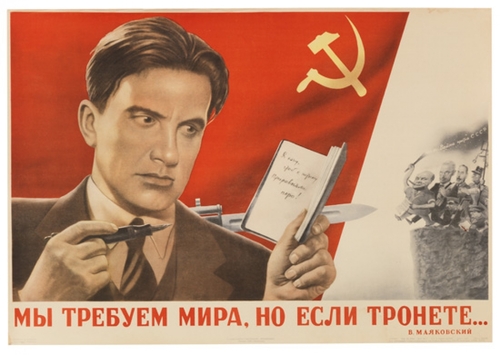
Vladamir Mayakovsky
Word Educator.
There is no qualitative difference between the slogans and cartoons that poet Vladimir Mayakovsky banged out for the Bolshevic propaganda effort and modern cereal boxes artwork.
Now in Hackney, trendy cafes can be seen adorned by 1950’s Hollywood posters and 1920’s grocery advertising.
Poetry for poetry’s sake
Poetry for poetry’s sake is a small part of our innate human capacity to use language beautifully, creatively, musically and metaphorically. Poetry (whatever that is) can be playful and throw-away, like Lewis Carol, Roald Dahl or John Hegley, epic like Dante, and esoteric like T.S Elliot. It can be yelled at an audience of thousands of festival munters, or cryptically encoded like a crossword. It can be written on a toilet door, whispered in a moment of post coital improvisation or spray painted onto a bridge. Indeed, there are so many manifestations and features to this art form that few people can agree on what it is. One thing is certain – it doesn’t belong to ‘poets’.
Sometimes poetry sells play play-doh, banana holders and baby wipes. Often it is crap, truly crap. But then, allot of what is written and spoken by people who identify as poets is crap. I say this as someone who spent many years writing and performing crap poetry.
Selling Out?
So why is it that artists who “sell out” receive such sustained criticism? I think it is because art cannot be separated from its who, where, when and how. The motivations, the financing and the dissemination of art is intensely political, and for good reason. Ideas are powerful, and every dictatorship and social movement has had its own aesthetic and artistic genre. Even if art does not consider itself “political”, art has agency in the world and can perpetuate and validate social norms and behaviours that can have good or bad consequences. So much art (including poetry) produced in large scale commercial advertising is nefarious for the sake of profit. Much of it is a danger to public and environmental and mental health. We have marketing specialists and sloganist to thanks for the obesity epidemic, arms fairs, public complicity on illegal wars, suicides and eating disorders. Almost none of it fundamentally challenges the the dominant capitalist – materialist paradigm that we have to blame for the

Poetry advertising planetary health
ecological, economic and social collapse humanity is now facing. These moral arguments are valid and are part of the truth that give artists integrity.
Little of what is produced in commercial advertising will be remembered for capturing the human experience in a new way or articulating great moments of history, large or small. That’s fine, it’s not trying to. Its producing a product fit for purpose – and it does so very well. What is more, it will continue to do so as long as we keep buying it.
Firing the Canon
The challenge for us is to switch off from it and find ways to spread ideas worth sharing in creative ways. We have no choice and there is little time. Spoken word artists in this country have been particularly successful in recent years in reigniting imaginations and mobilising hearts and minds – see Kate Tempest, Danny Chivers, Holly McNish to scratch just the skin of it. Poetic communities are spaces where ideas are shared, voices cultivated and critical thinking exercised. None of it involves sitting in front of a TV. In the words of spoken word poet, and modern day orator, David Lee Morgan: ‘Poetry is part of the cultural mix that keeps that the spirit of freedom and the desire to fight against injustice burning in all our hearts’. Now is the time to reclaim our language and revivify it as something insightful, questioning and positively inspiring. That would be truly beautiful.

Subvertisement
Sorry, the comment form is closed at this time.